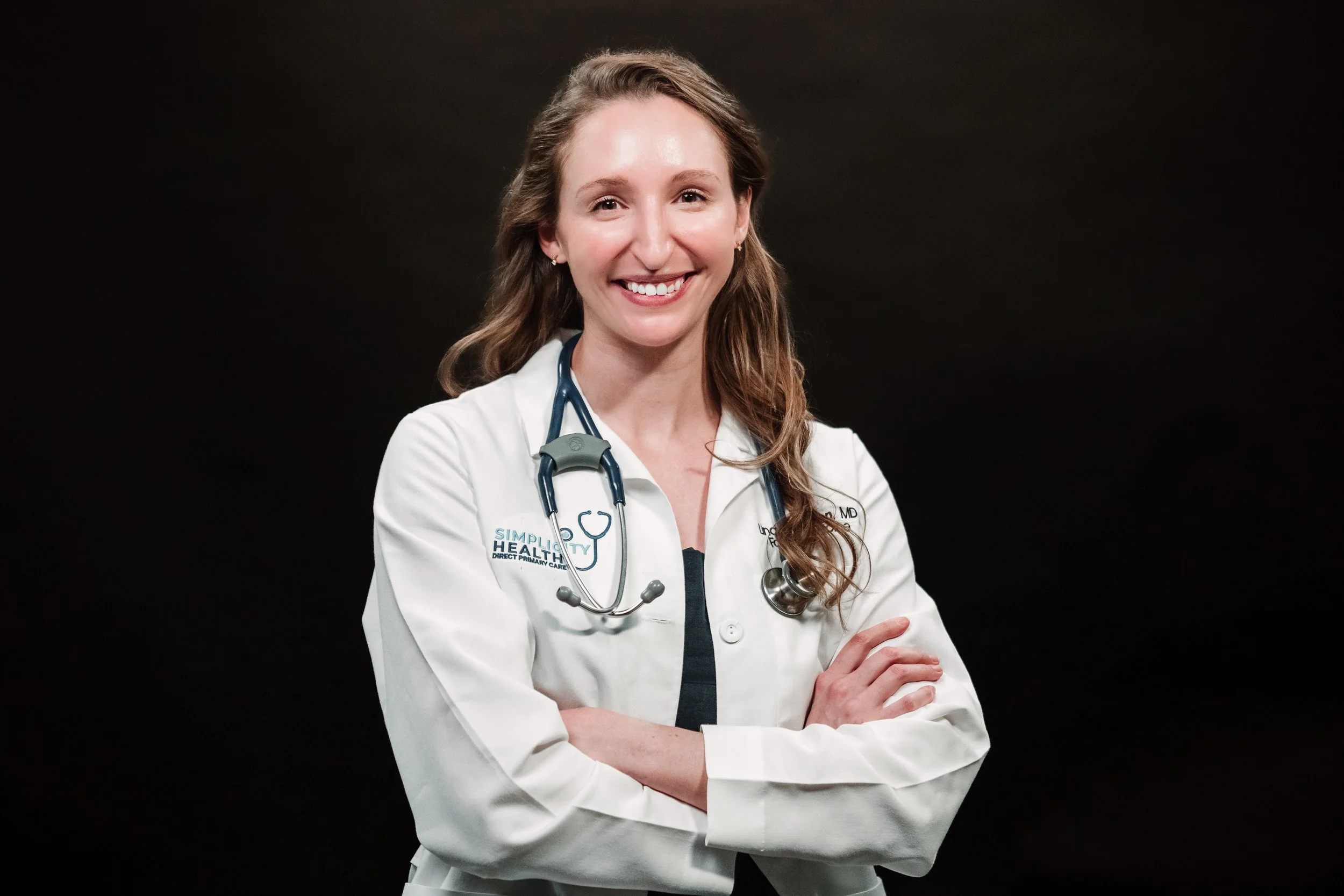

One Month In: What 5 Patients Per Day Give Me that 21 Never Could
Twenty-one patients a day. A patient panel north of 2,000. Lugging out the laptop to close charts from home while my husband went to hang out with friends.
That was my life in corporate medicine, a constant treading of water where I knew a patient's medications and diagnoses, but rarely much else.
The patients I actually got to know well were almost always the sickest ones: the ones who struggled to navigate a fragmented system of specialists, referrals, and prior authorizations, who looped back to our office once a month because their health was never really improving, despite my best efforts.
Their unanswered portal messages, their unexpected bills, the runaround they heard from the specialists, the denials, weighed on me every day.
Even the relatively healthy patients, I saw in fifteen-minute snapshots that always left me apologizing that we wouldn't be able to address all of their concerns that day.
Today, at Simplicity Health DPC, I see about five patients a day. I plan to cap my panel size at about a quarter of what was expected by a corporate system.
On paper, that looks like less medicine.
In practice, it's the opposite.
On Time as Medicine
The foundation of primary care should be preventative care, and preventative care takes time.
It's not enough to know a patient's medications, surgical history, and allergies. I need time to ask about their nutrition, their exercise habits, their sleep, how they're managing stress.
So many of the conditions I treat are influenced, at least in part, by how someone lives.
The hard part of medicine has never been the science — if it was, AI would be quick to replace us. Practicing less medicine more times a day does not mean practicing more medicine.
The hard part is understanding what actually motivates a specific person to make a change and stick with it, and that takes conversation, not a checklist.
I finally have the time to have that conversation.
Less volume buys me more minutes in the room with a patient, sure, but it's time outside the appointment that matters too — time to sit with a complicated case and actually think it through, to look into a more cost-effective option instead of defaulting to whatever's fastest to order.
Time to be genuinely available when a patient calls with a follow-up question instead of routing them through a phone tree.
Time to know the conversations that are occurring on podcasts and social media so that I can address concerns from patients in the office with an evidence-based approach and stop misinformation in its tracks.
I can offer procedures and treatments now that I would previously have had to refer patients out for, which means I'm building skills I'd otherwise lose and keeping more of a patient's care under one roof.
I have a different job than I did a month ago, even though the title hasn't changed.
On Working for Patients, Not Admin
Perhaps the deepest source of my frustration in corporate medicine was what the volume was actually for.
My compensation was tied to metrics that had little to do with whether my patients got better — visit counts, panel sizes, "wellness visits" that don't cover if you have real concerns, accessibility.
Even when I told leadership I was okay making less money for a more manageable workload, the message never changed: see more, bill more, produce more, despite my being one of the top producers in the system.
The reason was never really a mystery.
More volume meant more margin above and beyond what got paid out to their physicians.
Cleared the inbasket today and decided to reward yourself with a 20-minute Starbucks run at lunch? There are another 14 messages waiting when you get back.
92-year-old wheelchair-bound Ms. Jones called and her BP is running high since her cardiologist changed her medication, and their office closes at 2:00 on Fridays? She'll have to find a ride to come in, because managing it over the phone is uncompensated and can threaten liability concerns outside the confines of a paid and documented visit.
The percentage of your patients who completed their colonoscopies dropped from 72% to 69% this year? How can you fix that to meet our standard threshold of 70%?
More, more, more, with no ceiling and no finish line.
It didn't matter how well I knew my patients or how much they trusted me.
What mattered was the number next to my name at the end of the month.
Here, that equation looks different.
My compensation is tied to whether my patients feel well cared for, and to their long-term health — their actual lifespan, not their visit count.
If I'm doing right by them, they keep paying for higher-quality care through their membership fees.
The patient is the one with the contract with me now, not a corporate system with administrator-driven metrics.
When a patient is the one paying me directly, I'm incentivized by what matters to them, not by what matters to an insurance company.
On Patient Relationships and Community
One of the privileges of this new role is joining a practice that's already established in the community, with most referrals coming the old-fashioned way: word of mouth from satisfied patients.
As a new physician here, it's exciting to see people walk in already trusting the practice before they've even met me.
That trust deepens fast during meet-and-greet visits, which feel less like intake appointments and more like real conversations.
Patients tell me about the small business they run locally.
Or that they live out of state but need a healthcare option here because they're traveling in often to care for a sick relative.
Or that their sister-in-law is a patient here and finally feels like she found someone who listened to her about that persistent dizziness, and it turns out it was a side effect from a medicine she didn't even need anymore.
The demand itself has been its own kind of education — patients aren't just choosing DPC because they stumbled into it.
Many of our patients are fed up with the system too, and caring for them feels like investing back into the same community that's sustained this practice for years, and now sustains me.
On Mentorship
That same margin of time has changed my experience as an early-career physician, too.
In my old job, "mentorship" meant a well-intentioned but rushed hallway conversation between patients, if it happened at all.
Everyone was too busy staying above water themselves to even tell me which way to swim.
Here, the physicians I work alongside have the mental bandwidth to actually teach: to sit with me after a tricky visit and talk through what they might have done differently, or a recent study they'd read, without either of us glancing at the clock.
I didn't realize how much I'd been missing until I had it.
On Staff
The same is true for the staff I work alongside — genuinely some of the best nurses I've worked with in my career.
Dr. Opperman has worked hard to select talented people who started off ahead of the pack, but I can also see the structural forces at play.
When a nurse isn't juggling triage calls for forty patients a day, she has the mental space to be proactive instead of purely reactive: to notice a patient's blood pressure logs look off before it becomes a crisis, to follow up on a referral without being asked, to flag something in a chart because she actually had time to read it closely.
Drowning people can only react, not anticipate, which is exactly what leads to patients getting the run-around when they call in.
Low volume is a gift to me as a physician, but it's also a gift to the entire care team.
On My Own Health
As it turns out, DPC is better for your doctor too.
One month in, and I'm untraining myself from a feeling I've been carrying for years: that there was always something left unfinished, unaddressed, unasked because the clock ran out first.
We call it "pajama doctoring," the second, unpaid shift that starts after dinner, on the couch, answering portal messages, fighting an insurance company over a denied prior auth, chasing down a lab result, making sure a refill actually went through.
None of it counted toward my compensation.
All of it counted toward my exhaustion.
I don't lie awake anymore ruminating about the twelve charts I didn't close that day, waiting for me over the weekend.
I'm excited to leave for work in the morning, and I actually have energy left over when I get home.
Enough to prioritize my own exercise and nutrition, the same things I've been preaching to patients for years without fully practicing myself.
I couldn't just tell my patients how to live well.
I needed the time to do it too.
One month isn't long enough to know everything this will become.
But it's long enough to know that seeing fewer patients hasn't meant practicing less medicine — it's meant practicing more of it, the way it was supposed to be practiced all along.
— Lindsay Marton, MD