
Healthcare without the middlemen.
Direct Primary Care is the simple idea that your doctor should answer to you, not to insurance companies, hospital networks, or billing systems. Here's how it works and why it works better.
You pay your doctor. Your doctor stops billing insurance.
In exchange, you get longer visits, same-day access, in-house lab and pharmacy, transparent pricing, and a physician who actually has time to listen.
That's the whole idea. The rest of this page is the details, the math, and the answers to the questions most people have before they sign up.
You are no longer a number.
Two different models. Two very different experiences.
The traditional fee-for-service model and the Direct Primary Care model run on completely different incentives. Here's what changes.
The insurance-driven model
- 3,000 to 4,000 patients per doctor
- 7 to 15 minute appointments
- Insurance bills for every interaction
- Prior authorizations and claim denials
- Surprise bills, sometimes months later
- Phone trees and triage lines
- Productivity-driven scheduling
- Treatment plans shaped by billing codes
The Direct Primary Care model
- Roughly 400 patients per doctor
- 30 to 60 minute appointments
- Flat monthly membership
- No insurance billing for primary care
- Transparent pricing for everything
- Direct access to your doctor
- Schedules built around real conversations
- Treatment plans built around you
Three things change when your doctor stops working for the insurance company.
Time.
Most doctors in the traditional system are paid based on productivity. The more patients they see in a day, the more revenue the practice generates. Faster visits, more visits, more billing. It's a system that rewards volume over depth.
At Simplicity Health, panels stay small, roughly 400 patients per physician. That number isn't arbitrary. It's the math behind why your appointment can last 30 to 60 minutes instead of seven. It's also why your doctor can remember your story without scrolling through your chart.
Picture a 7-minute haircut. Barely time to sit down, explain what you want, and rush through the basics before the next person takes your chair. The barber doesn't get to know what looks right on you. You don't get to mention the thing you've been thinking about for weeks. Nobody's happy with the result.
That's the average primary care visit in this country. We think your health deserves more time than your hair.
Quality.
Time changes everything about how a doctor practices. With fewer patients, your physician can research your condition between visits, call the specialist on your behalf, and read the current literature on what's actually affecting you.
Quality also means avoiding the trap of HCC coding. HCC stands for Hierarchical Condition Category, and it's how insurance reimburses primary care. The more diagnoses on your chart, the higher the reimbursement. The system, intentionally or not, rewards making the patient "sicker." Our financial incentive runs the exact opposite direction.
Savings.
DPC isn't insurance. It replaces the part of primary care that insurance handles poorly and leaves insurance to do what it does well: cover catastrophic events like hospitalizations, surgeries, and specialist care.
For most members, the everyday math works out. Office visits and direct physician access are included in your monthly membership. Lab work and common prescriptions cost a fraction of what you'd pay through traditional channels. Your doctor writes the prescription, and many common medications can be picked up at our front desk on your way out. No separate pharmacy stop.
We've also negotiated direct pricing with imaging centers for MRIs, CTs, and ultrasounds. These often come in around 80 to 90% below sticker price.
Concierge attention. Direct Primary Care pricing.
Direct Primary Care and traditional concierge medicine share most of the same DNA. The biggest difference is who can afford to access it.
Traditional concierge practices typically charge $3,000 to $10,000 per year for membership, and many still bill your insurance on top of that fee. The model was built for executives and high-income households.
Direct Primary Care delivers the same core experience, smaller patient panels, longer visits, and direct doctor access. The difference is a flat monthly membership instead of a five-figure annual fee, with no insurance billing for in-house services.
At Simplicity Health, that means concierge-style care at prices that work for most household budgets. Many members pay less per month than their phone bill.
Traditional Concierge
- Often still bills your insurance on top
- Built for high-income households
- Premium positioning and branding
- Common in major metro markets
Direct Primary Care · Simplicity Health
- No insurance billing for primary care
- Built for accessible everyday use
- Family-owned and locally rooted
- Award-winning practice in Centerville, Ohio
Built as the opposite of assembly-line medicine.
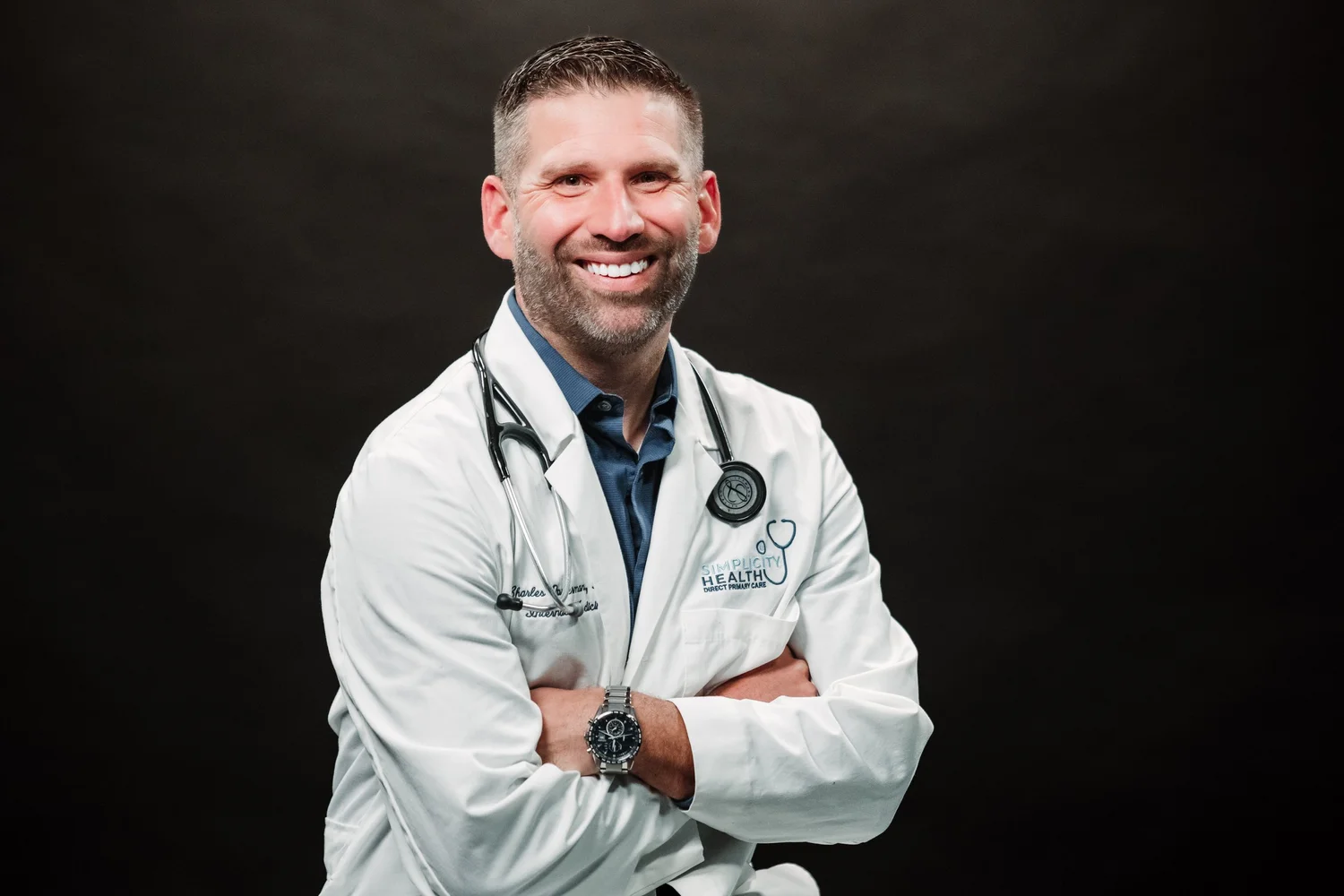
Dr. Charles Opperman founded Simplicity Health after years inside the traditional healthcare system. He watched patients rushed through seven-minute visits. Diagnoses missed because no one had the time to listen. Bills that didn't match the care delivered. A system that felt designed around billing rather than healing.
"Traditional medicine started to feel like serving gas station sushi. Technically food, but nothing you'd want for your family."
Simplicity Health is what happens when a physician decides to build the opposite. Our doctors keep small, intentional patient panels so they can spend real time with each patient, follow up properly, and handle the things primary care has always been responsible for, before insurance broke the model.
Modern medicine. Old-fashioned service. Directly between you and your doctor.
What does it actually cost?
Direct Primary Care pricing isn't a mystery, and it isn't a slogan. Our calculator shows you exactly what a year of care looks like at Simplicity Health, broken down line by line: membership, labs, medications, imaging, and the rest.
Try the cost calculatorWhat people ask before they sign up.
Do I still need health insurance?
Yes, we recommend it. DPC handles the everyday and ongoing care that most people need most of the time. Health insurance still matters for the things DPC doesn't cover: hospitalizations, ER visits, specialist care, surgeries, and major medical events.
Many of our members carry a high-deductible plan or catastrophic coverage alongside their Simplicity Health membership. Learn how DPC pairs with a high-deductible plan →
Will my insurance refund any of the membership fee?
No. The membership isn't billed through insurance, so insurance won't refund any part of it. That's actually how the cost stays low. We don't pay billing staff, prior-authorization staff, or coding specialists to run the practice. Those savings get passed back to you.
What if I need a specialist?
Your Simplicity Health doctor can refer you to specialists and coordinate your care, the same way a traditional primary care physician would. Specialist visits and any procedures will typically run through your insurance.
Because our doctors actually have time between visits, they often handle the legwork of finding the right specialist for your situation and getting you in.
Can I use my HSA or FSA to pay for membership?
HSAs, yes. Recent federal legislation made HSA funds eligible for Direct Primary Care memberships, and all of our tiers can be paid with HSA dollars. Bring your specific HSA plan details to your meet and greet and we'll walk you through how it works for your situation.
FSAs depend on your plan administrator. Some allow DPC memberships, others don't. Bring those plan details too and we'll help sort it out.
Does this work with Medicare?
Yes. If you have Medicare, you can still join Simplicity Health, and your Medicare coverage continues to handle outside services like hospital care, specialists, and imaging that we refer you for.
I'm healthy. Why would I pay monthly for care I don't use?
Two answers. First, when you do need care, it's right there with no wait and no insurance gauntlet. Second, the goal of primary care isn't to treat sickness, it's to prevent it. Having a doctor who knows you and has time for your questions is what makes prevention actually work.
What happens with my prescriptions?
After your doctor writes the prescription, many common medications can be filled at our in-house pharmacy. The pricing is usually a fraction of what a commercial pharmacy charges, and for a lot of medications, it ends up less expensive than running the prescription through your insurance.
You always have the option to send your prescription to any pharmacy you'd like and use your insurance if it works in your favor for a particular medication. Just let your doctor know your preference.
A few things we don't do in-house: compounded medications, brand-name drugs that are still on patent, and weight-loss injectables like GLP-1s. For those, we send the prescription to the pharmacy of your choice and you go through the normal insurance-based routes for coverage.
What about lab work and imaging?
Most routine labs are drawn in our office and processed through our negotiated lab partners. The pricing is typically a fraction of what insurance would bill for the same test, and in many cases, paying our cash price out of pocket is cheaper than running it through your insurance.
For imaging like MRIs, CTs, and ultrasounds, we've negotiated direct pricing with regional imaging centers that often runs 80 to 90% below sticker price.
If you'd rather use your insurance for a specific lab or scan, just say so. We'll send the order wherever you prefer.
Come meet us. No commitment.
A free meet and greet is the easiest way to see if Direct Primary Care is right for you. Twenty minutes. Ask anything.